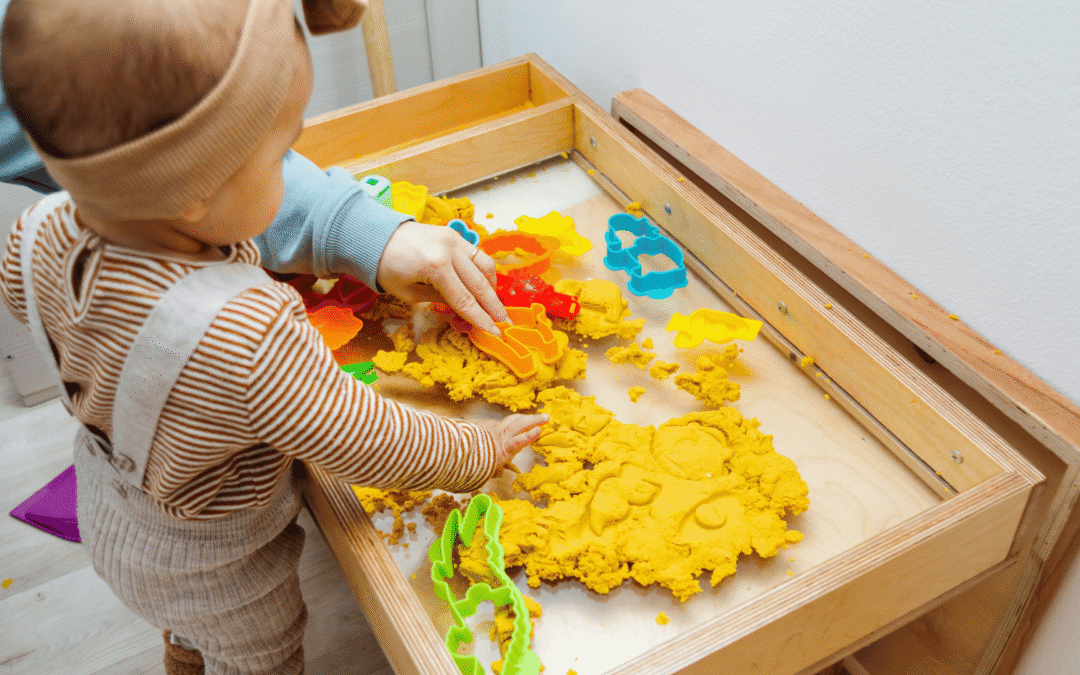
When adults think about learning, they often picture reading books, solving math problems, or writing on paper. For young children, learning begins much earlier and in a very different way. Before children can understand symbols, numbers, or letters, they first explore the world through their senses.
Every texture, sound, shape, color, weight, and scent helps build the foundation for future learning. A child compares the softness of a blanket, notices the roughness of tree bark, hears the difference between loud and quiet sounds, and observes that one object is taller than another. These everyday experiences help organize the brain and create meaningful connections.
This is why Montessori Pre-K places such a strong emphasis on sensorial exercises. They are not simply engaging in classroom activities. They are a carefully designed part of the early childhood curriculum that helps children classify, compare, and understand the physical world before moving on to abstract concepts.
For families exploring preschool enrollment, understanding the purpose of sensorial learning offers valuable insight into what makes Montessori education unique.
Sensorial Exercises: Learning by Seeing, Touching, and Listening
One of the defining characteristics of a Montessori classroom is the beautiful collection of sensorial materials displayed on open shelves. Each material has one specific purpose and is carefully designed to isolate a single quality, allowing children to focus deeply without unnecessary distractions.
Rather than asking children to memorize information, Montessori invites them to experience it.
Children hold, compare, arrange, and repeat activities until they naturally understand the concept being presented.
This hands-on approach creates lasting learning because children are actively involved in the process.
Some of the most recognizable Montessori materials are designed to strengthen visual discrimination.
The Pink Tower consists of ten smooth, solid pink cubes that gradually decrease in size from large to small. As children carefully stack each cube, they begin to notice differences in dimensions, proportions, balance, and sequence.
Nearby, the Brown Prisms, sometimes called the Brown Stair, introduce another visual challenge. Each prism has the same length but gradually changes in width and height. Children arrange the prisms from thickest to thinnest, refining their ability to compare dimensions with increasing precision.
To an observer, these activities may appear simple. In reality, children are developing visual perception, concentration, sequencing skills, and spatial awareness while preparing their minds for future mathematical thinking.
Montessori education recognizes that learning extends far beyond what children can see.
Touch Tablets invite children to gently run their fingertips across surfaces ranging from smooth to rough. Without relying on sight alone, children strengthen tactile discrimination and become more aware of subtle differences in texture.
Another fascinating material is the Sound Cylinders. These small wooden cylinders appear nearly identical from the outside, but each contains materials that produce different sound levels when shaken.
Children carefully listen, compare, and match pairs based solely on volume and tone. Activities like these sharpen listening skills, improve attention to detail, and encourage focused concentration.
These experiences help children trust their senses while building confidence in their own observations.
The Secret Purpose: Laying Concrete Foundations for Abstract Math
Parents often wonder how stacking cubes or matching sounds prepares children for academic success. The answer lies in how the brain develops during the early years.
Before children can understand abstract mathematical ideas, they need concrete experiences that help organize information.
When children arrange the Pink Tower from largest to smallest or order the Brown Prisms by width, they are learning classification, sequencing, comparison, and pattern recognition.
These same mental processes later support geometric relationships, the comparison of quantities, and the solution of increasingly complex problems. Instead of memorizing concepts too early, children build understanding through repeated sensory experiences.
The hands learn first. Then the mind understands. This progression is one of the greatest strengths of the Montessori early childhood curriculum.
Investing in Sensory Intelligence
Children remember what they have explored with their hands, observed with their eyes, and discovered through careful investigation.
Sensorial exercises strengthen concentration, observation, problem-solving, language development, and critical thinking while creating strong cognitive pathways that support lifelong learning.
In a Montessori pre-K classroom, every carefully designed material has a purpose. Each exercise helps children make sense of the world while laying the foundation for future success in mathematics, science, language, and beyond.
If you are considering preschool enrollment and want to experience the Montessori approach firsthand, we invite you to schedule a tour of our classroom. Seeing children engaged in sensorial exercises is one of the best ways to understand how purposeful, hands-on learning prepares them for a lifetime of curiosity and confidence.